
Penile Prosthesis

Does a Penile Implant Affect Fertility?
Penile Prosthesis

Does a Penile Implant Affect Fertility?

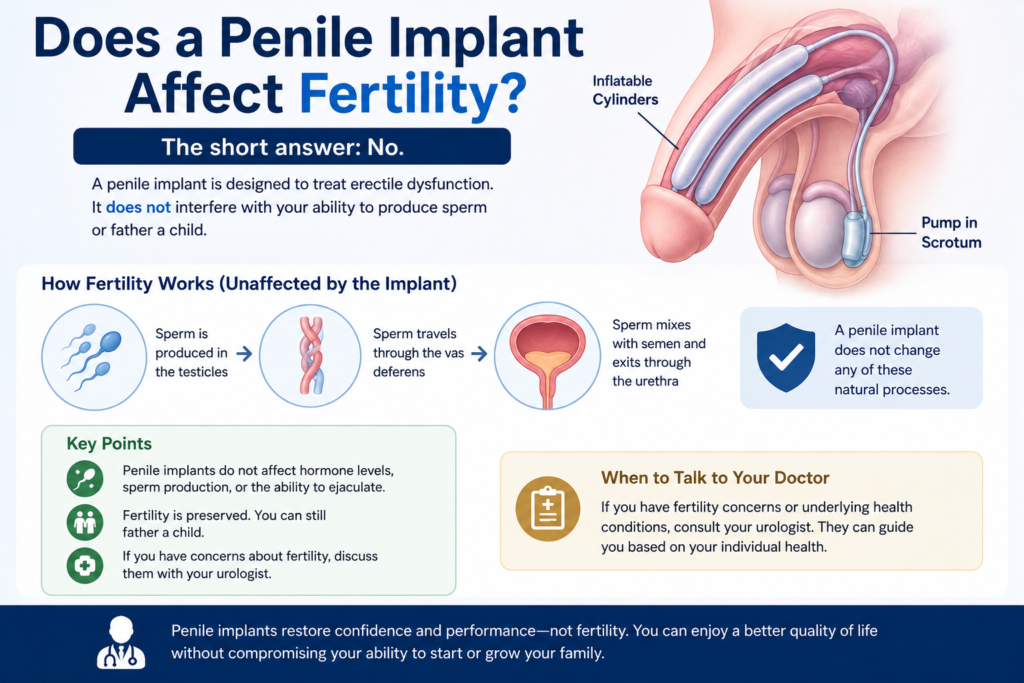
Does a Penile Implant Affect Fertility? Introduction If you’re considering penile prosthesis surgery  and still hope to have children someday, this question matters deeply, and it’s a completely fair one to ask before moving forward. The good news is that the answer brings genuine reassurance once you understand how the body’s different systems actually work. What Does Fertility Actually Depend On? Fertility relies on two separate things: healthy sperm production in the testicles and successful delivery of that sperm during ejaculation. These processes are controlled by a completely different part of the body than the one involved in achieving an erection. Understanding this separation is the key to answering the fertility question clearly. Where Is a Penile Implant Actually Placed? The device is placed within the erectile chambers of the penis, the tissue responsible for rigidity during an erection. It doesn’t touch the testicles, the tubes carrying sperm, or the nerves involved in sperm production. Because of this specific placement, the implant works independently from the reproductive system entirely. Does the Implant Affect Sperm Production? No, sperm production continues normally in the testicles, completely unaffected by the implant. The two systems simply don’t overlap anatomically, so one doesn’t interfere with the other. This is one of the most reassuring facts for men worried about this connection. Does the Implant Affect Ejaculation? Generally, no. Most men retain the ability to ejaculate normally once healing is complete. The pathways involved in ejaculation remain separate from where the implant sits. Sensation and the ability to reach orgasm are also typically preserved after surgery. Can You Still Father Children After Getting a Penile Implant? Yes, many men go on to father children after this procedure without any issue related to the implant itself. The device only addresses the mechanical ability to achieve firmness for penetration. Everything involved in actual conception remains functionally unchanged by the surgery. Are There Situations Where Fertility Could Still Be a Concern? If the original cause of erectile dysfunction, like diabetes, prior surgery, or a hormonal imbalance, also affects fertility, that connection exists separately from the implant. Age-related changes in sperm quality are a separate factor entirely, unrelated to this procedure. Being honest about these distinctions helps you understand your specific situation rather than assuming the implant itself is the limiting factor. Should You Discuss Family Planning Before Getting an Implant? Yes, if having children in the future is part of your plans, it’s worth raising this directly with your doctor beforehand. Sperm banking can be considered as an additional precaution if there’s any uncertainty about your fertility for other reasons. This isn’t because the implant itself poses a risk, but because open conversations lead to better peace of mind. Does the Type of Implant Make a Difference to Fertility? No, there’s no meaningful difference between inflatable and malleable implants when it comes to fertility. Both types are placed within the same erectile chambers, well away from any reproductive structures. Your choice between the two comes down to lifestyle and preference, not fertility concerns. What Should You Ask Your Surgeon Before Moving Forward? Whether any underlying condition you have might separately affect your fertility. Whether sperm banking makes sense for your specific situation and timeline. What your realistic expectations should be for sensation, ejaculation, and overall function afterward. Asking these questions directly helps you move forward with genuine clarity rather than lingering doubt. Final Thoughts A penile implant addresses the ability to achieve a firm erection, nothing more, and it doesn’t interfere with the separate systems responsible for sperm production or fertility. If starting or growing a family is part of your future plans, an honest conversation beforehand brings real peace of mind. Dr. Kunal Aterkar, offering trusted penile prosthesis surgery in Ahmedabad, can walk you through exactly what applies to your specific situation.
What Is a Penile Prosthesis and How Does It Work?
Penile Prosthesis

What Is a Penile Prosthesis and How Does It Work?

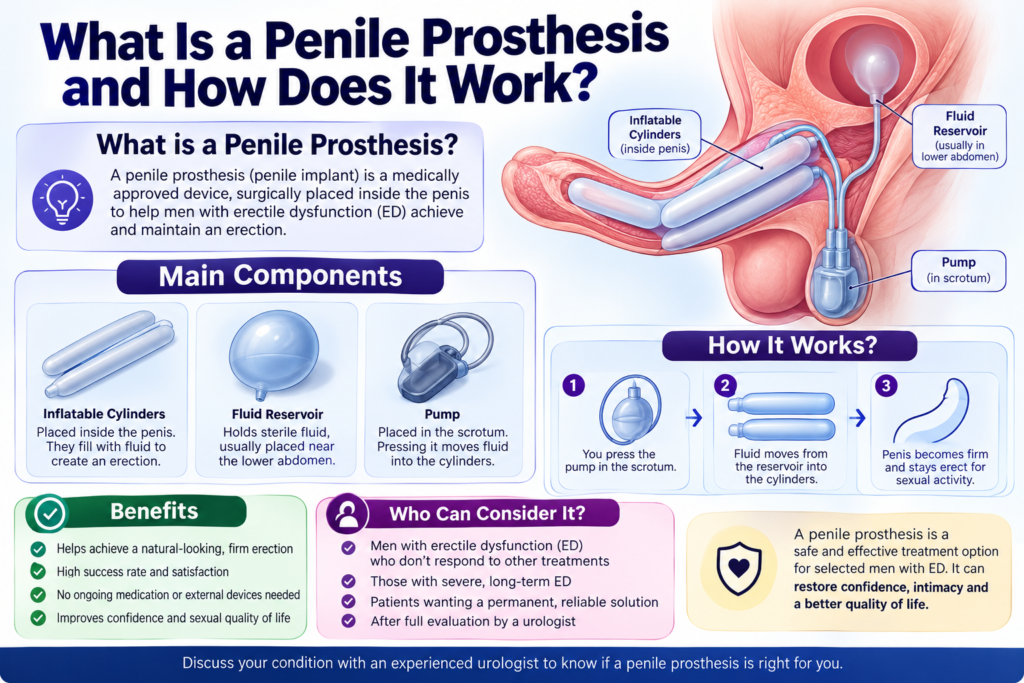
What Is a Penile Prosthesis and How Does It Work? Introduction Talking about erectile dysfunction is hard enough, let alone researching surgical options for it. If you’ve tried other treatments without success and are now reading about penile prosthesis surgery in Ahmedabad, know that this is a well-established, medically respected option, not a last resort to feel uneasy about. Here’s a clear, judgment-free explanation of what it actually involves. What Exactly Is a Penile Prosthesis? It’s a medical device surgically placed inside the penis to help achieve an erection reliably. It’s typically considered when other treatments, like medication, injections, or vacuum devices, haven’t worked well. This procedure has been performed safely for decades and is a recognized, established solution worldwide. For many men, it becomes the option that finally restores confidence after a long, frustrating search for answers. Who Is This Treatment Typically Recommended For? Men whose erectile dysfunction hasn’t responded to pills, injections, or other non-surgical treatments. Those with underlying conditions like diabetes, prior prostate surgery, or Peyronie’s disease affecting penile shape. Men who’ve experienced ED following spinal cord injury or certain nerve-related conditions. Anyone seeking a dependable, long-term solution rather than one requiring timing or planning around use. What Are the Different Types of Penile Implants? Inflatable implants, the most commonly chosen option, allow a natural-feeling flaccid state and a firm erection on demand. Malleable, or semi-rigid, implants are simpler devices that stay firm but can be positioned as needed. Each type has its own advantages, and your surgeon will help determine which suits your anatomy and lifestyle best. How Does the Inflatable Type Actually Work? A small pump is placed within the scrotum, alongside a fluid reservoir inside the body. Squeezing the pump moves fluid into cylinders placed within the penis, creating an erection. A release valve allows the fluid to flow back, returning to a natural, flaccid state afterward. Once you’re familiar with it, the process becomes quick and straightforward. What Happens During the Surgery Itself? The procedure is performed under anesthesia, so you won’t feel anything during surgery. A small incision is used to place the device, without significant external scarring. Most procedures take around one to two hours, often with a short hospital stay or same-day discharge. What Should You Expect During Recovery? Mild swelling and discomfort in the first few days is normal and expected. Light activity restrictions apply for a few weeks while healing progresses. The device typically isn’t used until full healing is complete, usually around four to six weeks. Follow-up visits help confirm everything is healing properly before use begins. Does the Device Affect Sensation or Become Noticeable? No, natural sensation and the ability to reach orgasm are generally unaffected, since the device only supports the erection mechanism itself. Once healed, the implant isn’t noticeable to others in daily life or clothing. Many men are relieved to learn how naturally it integrates into everyday life afterward. What Are the Benefits of Choosing This Option? High satisfaction rates have been reported among both patients and partners in long-term studies. Unlike medication, there’s no need to plan or wait for treatment to take effect. It offers a reliable, long-term solution once healing is complete. For many men, it genuinely restores confidence that other treatments hadn’t provided. Are There Any Risks to Be Aware Of? As with any surgery, there’s a small risk of infection or complications. Mechanical components can occasionally require repair or replacement over many years of use. Choosing an experienced surgical team significantly reduces these risks and supports a smoother outcome. How Long Does the Device Typically Last? Many devices function reliably for ten to fifteen years or longer. If a mechanical issue does arise later, the device can usually be repaired or replaced. Isn’t a sign of giving up Deciding to look into penile prosthesis surgery in Ahmedabad often comes after a long, tiring search for something that actually works, and reaching this point says nothing negative about you. With the right surgical team, it tends to be the option that finally brings dependable, lasting results. Dr. Kunal Aterkar offers a private, understanding space to talk through your situation and figure out the right path forward together.

Scroll to Top